Built as if the record will be examined, because it will be
If something goes wrong at your event, your incident log stops being an operational tool and becomes evidence. SYNQE is engineered for that moment: a record that can be proven un-altered, access that can be proven appropriate, and data that can be proven separate.
The questionnaire answers, up front
What a procurement or insurance review asks first, including the rows where the answer is "not yet".
| Item | Status | Detail |
|---|---|---|
| Operational data stored in AustraliaApplication and database on Google Cloud, Sydney (australia-southeast1). Incident records, jobs, logs, rosters and health information stay there. | Yes | Application and database on Google Cloud, Sydney (australia-southeast1). Incident records, jobs, logs, rosters and health information stay there. |
| Media stored in-regionPhotos, video, documents and site plans on Cloudflare R2, Oceania jurisdiction. | Yes | Photos, video, documents and site plans on Cloudflare R2, Oceania jurisdiction. |
| Encryption in transitEvery connection, including media, which is served through short-lived signed links. | Yes | Every connection, including media, which is served through short-lived signed links. |
| Penetration testingAt each development milestone. All critical and high findings remediated. | Yes | At each development milestone. All critical and high findings remediated. |
| Breach notificationTo affected customers without undue delay, and within 72 hours of us becoming aware (Terms §11.6). | Yes | To affected customers without undue delay, and within 72 hours of us becoming aware (Terms §11.6). |
| Data Processing AddendumStandard DPA available on request, executed where required (Terms §11.1). | Yes | Standard DPA available on request, executed where required (Terms §11.1). |
| ISO 27001 or SOC 2 certificationNeither is held. The controls on this page are real but not independently certified. | Not yet | Neither is held. The controls on this page are real but not independently certified. |
| Contractual uptime SLAThe standard Terms carry no uptime commitment. Ask if your procurement needs one. | Not yet | The standard Terms carry no uptime commitment. Ask if your procurement needs one. |
| Single sign-on (SSO)Accounts use SYNQE's own sign-in, with rate limiting and password-reuse prevention. | Not yet | Accounts use SYNQE's own sign-in, with rate limiting and password-reuse prevention. |
Providers outside Australia
None of these receives your incident records. Each gets only what its job needs.
- StripePayment processing · United States and other regions
- ResendService, account and security email · United States
- CARTOMap imagery · European Union
- Browser push servicesPush notification delivery · Various
- TwilioWhatsApp delivery, only if you enable it · United States
- what3wordsThree-word addresses, only if you enable it · United Kingdom
One point of precision: stored in Australia isn't the same as beyond the reach of any foreign law. Google Cloud is a United States company, and data in its Australian region may in limited circumstances be subject to lawful access requests under laws that apply to it. Full detail is in the Privacy Policy.
If anyone alters the record, it shows
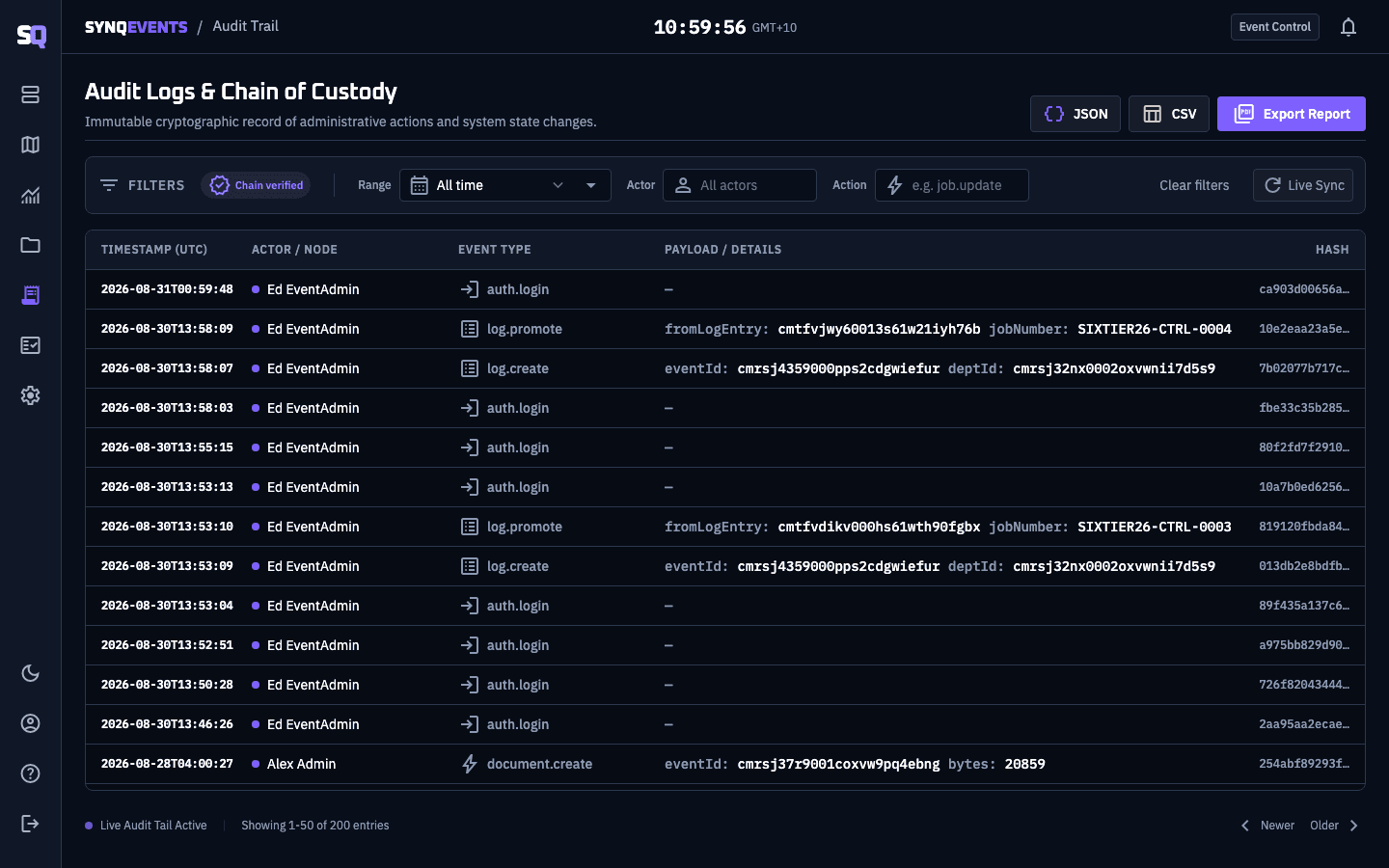
Every significant action is written to an append-only audit trail and cryptographically hash-chained: each entry includes a fingerprint of the entry before it. Change one historical record and every fingerprint after it stops matching.
Six tiers, plus visibility rules on top
Access is granted by capability tier, then narrowed by department. A medical volunteer sees what medical needs to see; a client rep sees the picture and changes nothing.
Separation by structure, not by policy
This matters most when you're a security firm working three competing promoters, or a venue hosting rival agencies in the same week.
What we can see, and how you'd know
Most vendors don't publish this. We think you should be able to read it before you sign anything.
Reviewing SYNQE for a procurement or insurance requirement?
Send us your security questionnaire. We'll complete it, and we'll tell you plainly where the answer is "not yet" rather than dressing it up.